Background
Scottish football is a unique and mesmerising world. In many ways, our game has provided many elements to what is now the modern version of the sport. Early playing rules were developed in Scotland, the idea of passing the ball instead of charging forward in a formation was started in Scotland and the instalment of a crossbar came about in Scotland. These innovative changes were the beginning of how we see football now, all brought together by one entity: Queens Park Football Club.
Queens Park are Scotland’s oldest association football club having been formed way back in 1867. Their historical, cultural and sporting legacy is unquestionable. The entire Scotland squad for the world’s first ever international football match consisted of Queens Park players. Our footballing home Hampden Park was built by Queens Park. The instigation of the Scottish Football Association and the creation of the Scottish Cup was led by Queens Park. So much of what we know and love about our game comes from this club from the southside of Glasgow, and that’s only scratching the surface.
Throughout the majority of their history, Queens Park have been an amateur side competing in a world where money has become an increasing necessity. They were formed under the motto Ludere Causa Ludendi, meaning ‘For the Sake of Playing.’ They believed that football should be played as a form of competitive camaraderie and should not be influenced by financial gains. In the early days of Scottish football, it worked. To this day, Queens Park have the accolade of winning ten Scottish Cups – the third highest in the country. They dominated Scottish football and regularly played in the ‘Football World Championship’ game against the winners of England’s FA Cup. They’ve won it four times.
Since the glory days of the late 1800s, Queens Park’s values, while admirable and respectable have arguably held them back in the greater scheme of the sport. Clubs around them began paying their players and offering incentives Queens Park couldn’t match with their amateur status. While the draw of playing for such a historical and innovative club was still high it is difficult to turn down being paid to play the sport you love. It is remarkable that Queens Park held their own for so long as an amateur club, winning all three lower divisions at some point in the last 70 years or so.
However, in 2019 it was time for change. After more than 150 years as an amateur side, it was decided that Queens Park would turn professional. 91% of Queens Park members voted the proposal through, ending the process of losing quality players for no compensation. It is no secret that Queens Park’s change has come with significant financial backing, allowing them to sign well-known, quality players to begin their life as a professional side. They skooshed League 2 at the first time of asking and won the League 1 play-offs the following year. The rise continued in the Championship and were one win away from promotion to the Premiership. However, a final day winner-takes-all defeat to Dundee and a play-off loss to Partick Thistle left Queens Park agonising on what could have been.
Ambition remains high and Queens Park certainly have heavy wishes for promotion sooner rather than later. The development of Lesser Hampden is seemingly representative of the club’s new era, even with their plans to play their league home games next door. For now though, the League Cup Group Stages are the priority. It is the weekend of the final round of matches, with Queens Park still having a chance (however slim) of progressing into the knockout rounds. Today, The Spiders face a ‘Battle of the Queens’ with Queen of the South travelling from Dumfries and Galloway with hopes of getting through the group themselves. Robin Veldman’s side will be hoping for a positive performance and three points to carry momentum into the upcoming league season. It feels as though it could be a cracker.

Facilities
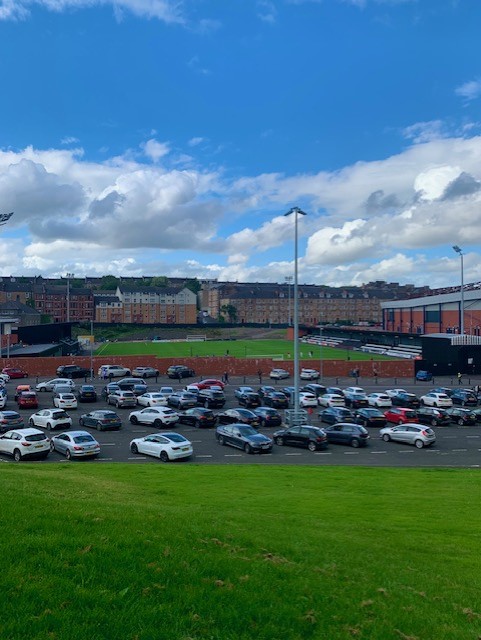
As a footballing arena, Lesser Hampden dates back 99 years to 1924. Originally built as a venue to host reserve and youth team games, it had an original capacity of 12,000. It is situated right next to Hampden Park and sits directly in the heart of Glasgow’s southside tenement jungle. Since its recent redevelopment it stands as a modern structure in an aged but nostalgic setting.
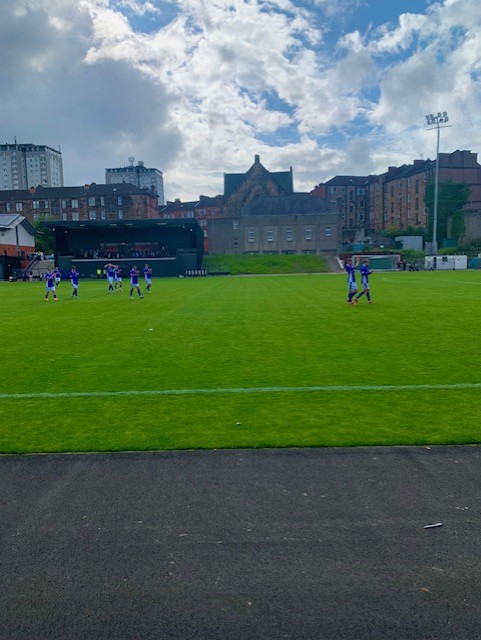
Speaking of said redevelopment, it has taken a bit of time and a more than expected amount of money to get it to where it is today. Running the entire length of the pitch, the West Stand provides a decent view of proceedings with five rows of seating. It is a fairly similar look and feel to Edinburgh City’s Meadowbank, only significantly better. Upon entrance to the stand, you’re instantly greeted with a decent looking food hut, leading up to the seating area. It all looks pretty slick and easy to navigate with a superb playing surface to boot. So far, so good.
On the opposite end of the ground lies a director’s box/stand. I won’t lie, it looks a bit daft. Its square look and isolation from anything else makes it stand out like a sore thumb. I also feel it places a strange dissociation between the support and the club hierarchy. I’m sure it serves its intended purpose well but for me it doesn’t look great.
With Queen’s Parks plans to play their league games at Hampden this season, it does give yet more time to bring Lesser Hampden up to a suitable size and standard for the club’s future ambitions. It almost feels as though their project has gone too well so far and has moved too quickly to build an appropriate venue to play in the Championship/Premiership. If Queens Park do end up promoted to the Premiership, I would not be surprised to see them play in Hampden for the foreseeable given the huge financial gains of hosting the country’s biggest clubs and largest supports every other week.
For now, Lesser Hampden does the job. It is more than suitable to host League Cup games and matches with a lower expected attendance. Although the director’s box is a bit of a weird structure, the rest of the stadium is perfectly fine as a footballing arena. 2.5/5.

Atmosphere
For games like this, having the ability to just pack out an entire stand is a positive for the matches’ atmosphere. Over 800 people were in attendance at Lesser Hampden, with the 200+ Queen of the South supporters making the majority of the noise throughout the game. All in all the game had a pretty friendly feel to it, with plenty of young kids attending with their parents. I always feel its important for young ones to support their local club whenever possible to build a connection. I feel Queens Park will certainly be able to do this in the coming years given their move back to Glasgow.
I feel the atmosphere in Lesser Hampden will be considerably better than what it’ll be in a half-empty Hampden, so it was nice to experience a closer and more compact version of what the supporter experience at Lesser Hampden can be. 3/5.

Quality of the Match
Both teams came into this Viaplay League Cup group stage match with a possible (yet outside) chance of qualification to the last 16. The Spiders were fresh from a five-goal demolition of Elgin City, while The Doonhamers were rueing a missed opportunity after losing on penalties to East Fife on Tuesday night.
The home side started the brighter of the two and went close after two minutes. Winger Jack Turner burst forward and unleashed a strike that went just wide of Gordon Botterill’s goal.
Marvin Bartley’s side returned with a few unanswered chances. First, a cutback to Gavin Reilly allowed the striker the opportunity to fire a snapshot at the home goal. Spiders goalkeeper Callan McKenna was equal to it though, producing a smart save down to his right-hand side. McKenna would be called into action again soon after as Cammy Logan burst through the Queens Park defence. With the just the ‘keeper to beat and the angle getting ever tighter, his attempted lob was well blocked by the onrushing Queens Park stopper.
The travelling support were sensing a goal was coming for their team and sure enough, they were up off their seats with around half an hour gone. With Queens Park striker Ruari Paton having to drop deep to collect the ball, his attempted cross field pass deflected off ‘South midfielder Harry Cochrane and into the path of forward Kieran McKechnie. McKechnie rounded Callan McKenna and rolled the ball into the net, only for the assistant to raise his flag.
That scare seemed to lift the home side to create a few chances of their own. First, the ever-lively Dom Thomas’ beat his man on the left before hitting a deflected cross. The QoS ‘keeper could only look on as the ball bounced off his crossbar and out for a corner. The bar would get no respite as it would be struck again five minutes later. With the away side struggling to clear a corner, the ball fell to Jack Thomson whose powerful effort left the upright shaking. Mightily unlucky.
With the home side in the ascendency towards the break, they perhaps should have been heading into half time a goal up. Jack Thomson once again involved, his low ball into the box found Dom Thomas. However, with virtually the last kick of the half, his strike from just inside the box flew high over Gordon Botterill’s goal. An exciting half, but no breakthrough thus far.
Half Time: Queens Park 0-0 Queen of the South

You’d have thought the message inside the home dressing room would have been to keep playing, pressing and exploiting the spaces in between the ‘South midfield and defence. They probably felt they had the better chances and were unlucky not to be in the lead and that their time was coming in the second half. However, football is a game with lightning quick turnarounds. Two minutes after the interval, Queens Park’s captain and defensive giant Charlie Fox was given his marching orders for a deemed last-man challenge. It’s a shame too, he’d been superb so far in the game. The home side were down to ten.
Weirdly though, Queens Park’s chances continued with the player deficit and they arguably looked better with ten men. Some excellent play by Barry Hepburn down the right-hand side saw him beat ‘South defender Kyle McLelland and cut the ball back to Louis Longridge. Most of the West Stand had the perfect view to watch his rifled strike fly just past Botterill’s right post.
However, The Doonhamers eventually got to grips with the situation and began to dominate the midfield. Their pressure showed in the form of a well-worked goal on the 65th minute. Josh Todd worked his man magnificently on the left before cutting a low ball back to his striker Gavin Reilly. With the ball on a plate, Reilly’s easy finish put the away side a goal up.
Queens Park did respond and continued to apply whatever pressure they could. Left-back Tommy Robson drew a smart low save from Botterill after charging into the box and unleashing a low strike.
In the space of 5 minutes, both goalkeepers would have different stories to tell. With Gordon Botterill having just kept his side ahead, Callan McKenna would have a moment to forget. The ‘keeper had almost been caught out with taking too long on back-passes throughout the game, and Queen of the South knew it. With McKenna dilly-dallying on the ball, Harry Cochrane charged towards him, tackled him cleanly and had the simple job of knocking the ball into an empty net. Not McKenna’s finest moment. 0-2.
Queens Park were still resilient and felt they could get back into the match. With ten minutes to go, some pinball in the box resulted from a weird lunging tackle from both sides to regain a loose ball. I’m not entirely sure what happened, but the referee deemed the ‘Doonhamers act to be an illegal one, with a penalty awarded to the home side. With the perfect opportunity to bring the hosts back into the match, four-goal hero and former ‘South player Ruari Paton stepped up. However, the goal-filling Gordon Botterill guessed correctly and produced a wonderful save to keep the away side’s two goal advantage.
The home side didn’t stop though. The introduction of former Arthurlie winger Aaron Healy brought some pace and agility to the side, and a moment of pure brilliance set up a nervy ending for QoS. Just outside the box, the ball flicked up, leaving Healy to produce a wonderful volley into the corner of the net. Botterill had no chance. 1-2.
There would be one final chance. After some excellent build up play, Ruari Paton wandered across the edge of the box before striking the ball goalwards. It looked destined to creep in at the far post but went agonisingly wide, much to the despair of the home supporters in front of me who had already leapt out of their seats in expectant euphoria. It wasn’t to be though. The away side would take the three points.
Full Time: Queens Park 1-2 Queen of the South

Queens Park will be a bit gutted not to have taken anything from the match. Even with ten men for essentially the entire second half, they will feel they had the better opportunities and squandered the chance to snatch a draw. It is clear how well versed they are as a team though and I feel they will be just fine heading into this Championship season. Despite his red card, I felt Charlie Fox was outstanding for the time he spent on the pitch and it is clear how important he is to this Queens Park side.
Queen of the South will have been delighted to head back down to Dumfries with a win against higher league opposition. I felt they were great for the most part and managed to establish some good tempo and passing play through the lines. The centre-back pairing of the legendary Efe Ambrose and Hibernian loanee Kyle McLelland looked solid for the most part, with plenty of attacking power at the other end. I wouldn’t be surprised to see The Doonhamers finish high in League 1.
Overall, I was treated to three goals, a red card, a goalkeeping howler and some all round superb individual performances. I think its fair to give this game a solid 3.5/5.

Pricing
I paid a reasonable £12 for this League Cup group stage tie, a price I believe to be fair at this level. Although I didn’t partake in any food or drink, it also looked well priced. For the experience, level of football and quality on show I think it’s fair to give a solid 4.5/5 for this.
Final Score
Queens Park end the day with a score of 13.5/20 for the experience at Lesser Hampden. Although it is not the finished product, it is certainly grand for a game at this level given the time and money that has been spent so far on the renovation. It looks as though the only way is up for Queens Park, and with the potential financial gains of using Hampden throughout the season, it might be difficult to stop Scotland’s oldest club returning to the top level. It’ll certainly be an interesting journey.
– Connor
 The Scottish Football Adventure
Leave a comment